
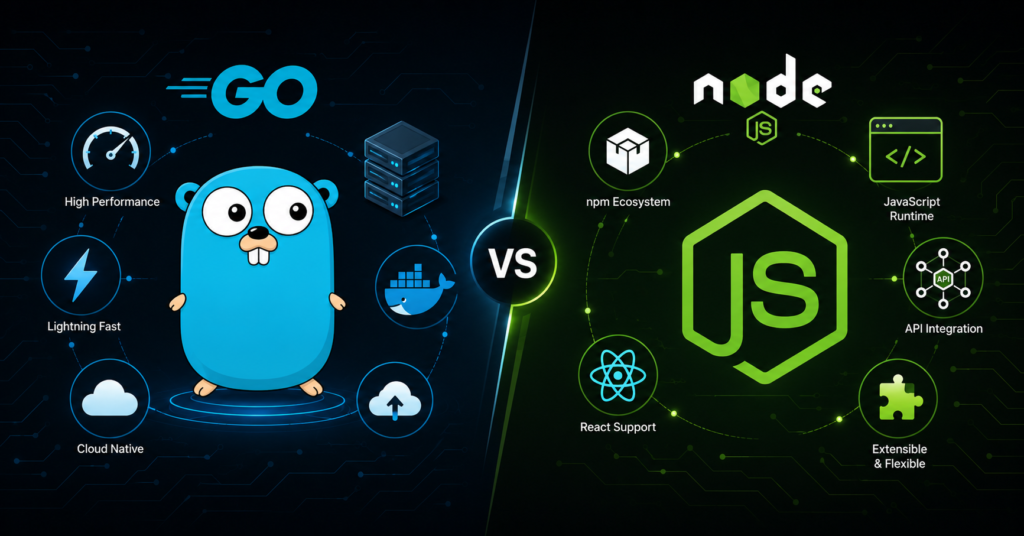
When it comes to choosing a backend technology for your software project, few decisions carry more long-term weight than the programming language and runtime your development team builds on. Get it right and your application scales effortlessly, performs reliably, and costs less to maintain over time. Get it wrong and you find yourself rebuilding critical infrastructure far sooner than your budget or your timeline anticipated.
For Australian businesses commissioning custom software in 2026, two backend technologies come up in conversations more frequently than almost any other: Go (commonly called Golang) and Node.js. Both are widely used, both have strong ecosystems, and both have genuine strengths. But they suit very different types of projects, teams, and long-term goals.
This guide breaks down the real differences between the two — in plain language, focused on what actually matters for a business commissioning software rather than a developer writing it.
What Is Golang?
Go is an open-source programming language developed by Google and first released publicly in 2009. It was built to solve specific problems that Google’s engineering teams were encountering at massive scale — problems around compilation speed, runtime performance, and the complexity of managing concurrent processes across large distributed systems.
Go is a statically typed, compiled language, which means code is converted directly into machine instructions before it runs rather than being interpreted at runtime. This gives Go applications a significant performance advantage, particularly for computationally intensive tasks and high-concurrency workloads.
Some of the world’s most performance-critical infrastructure is built in Go — including Docker, Kubernetes, and significant portions of Google’s own internal systems. This pedigree matters not just as a marketing point but as evidence of Go’s suitability for demanding, production-grade workloads.
What Is Node.js?
Node.js is not a programming language — it is a runtime environment that allows JavaScript to run on the server side, outside of a web browser. Released in 2009 and built on Google’s V8 JavaScript engine, Node.js brought JavaScript’s familiar syntax and ecosystem to backend development for the first time.
Node.js is event-driven and uses a non-blocking I/O model, which makes it well-suited to handling many simultaneous connections without significant performance degradation — particularly for I/O-intensive applications like APIs, real-time applications, and data streaming services.
The most significant thing Node.js brought to the table was not raw performance but ecosystem and familiarity. JavaScript is already the most widely used programming language in the world, meaning that web developers could suddenly contribute to backend development without learning a new language. This dramatically lowered the barrier to full-stack JavaScript development and fuelled Node.js’s rapid adoption.
The Core Technical Differences — Explained Simply
Before getting into which is better for your project, it helps to understand the fundamental differences between the two in terms that matter to a business owner or product manager rather than a systems architect.
How they handle concurrent requests:
This is perhaps the most important technical distinction for most business applications. Both Golang and Node.js are designed to handle many simultaneous requests efficiently, but they do so differently.
Node.js uses a single-threaded event loop — it processes one task at a time but delegates waiting operations (like database queries or external API calls) to the background, allowing other requests to be handled in the meantime. This works extremely well for I/O-heavy applications where the server spends most of its time waiting for external responses rather than performing computation.
Go uses goroutines — lightweight threads that can run concurrently across multiple CPU cores. This means Go can genuinely perform multiple tasks simultaneously, not just manage the appearance of simultaneous processing. For computationally intensive tasks or applications that need to process many independent operations in parallel, Go’s approach delivers meaningfully better performance.
Compiled vs interpreted:
Go code is compiled into a binary — a self-contained executable that runs directly on the target machine without any runtime dependency. This means Go applications typically start faster, consume less memory, and run with greater predictability than interpreted alternatives.
Node.js code is interpreted at runtime by the V8 engine. This introduces more runtime overhead and means the application depends on Node.js being installed in the deployment environment. For most modern deployment scenarios this is not a practical problem, but it is worth understanding.
Type system:
Go is statically typed — every variable has a defined type that is checked at compile time. This catches a large category of bugs before the code ever runs and makes large codebases significantly easier to maintain and reason about.
Node.js with plain JavaScript is dynamically typed — types are checked at runtime rather than compile time, which can allow bugs to surface in production that a compiler would have caught earlier. TypeScript — a statically typed superset of JavaScript — addresses this concern and is now the standard choice for serious Node.js projects, though it adds a compilation step and tooling complexity of its own.
Performance — When It Actually Matters
Go consistently outperforms Node.js on raw computational throughput. In benchmarks testing CPU-intensive tasks, Go applications typically complete workloads significantly faster and with lower memory consumption. For applications where every millisecond of response time matters — financial platforms, real-time processing systems, high-frequency trading systems, or large-scale data processing pipelines — this performance gap is genuinely meaningful.
For standard API servers handling typical web application workloads — accepting requests, querying a database, returning responses — the performance difference between Go and Node.js is often negligible in practice. Both are fast enough that your database query time or network latency will be the bottleneck long before the language runtime becomes the constraint.
The performance conversation becomes most relevant when your application needs to do one of the following: handle extremely high request volumes (thousands of concurrent connections), perform significant computation within the request cycle, process data in parallel across multiple CPU cores, or operate with strict resource constraints such as limited memory in containerised deployments.
If your project falls into any of these categories, Go’s performance characteristics are a genuine differentiator. If it does not, Node.js performance is entirely adequate for most business applications.
Developer Ecosystem and Availability in Australia
This is a practical consideration that many technical comparisons gloss over but that matters enormously for Australian businesses.
JavaScript is by far the most widely used programming language in Australia and globally. This means the pool of Node.js developers is significantly larger than the pool of Go developers — and larger pools typically mean lower hiring costs, faster team scaling, and more readily available freelance or contract support.
Go developers do exist in Australia, including in Adelaide’s growing technology sector, but they represent a smaller and more specialised talent pool. For businesses building long-term in-house development teams, this difference in developer availability is worth factoring into the decision. For businesses working with an experienced development agency that already has Go expertise — as is the case with StepSharp’s development team — it is less of a constraint, since the team already exists.
The npm ecosystem (Node.js’s package registry) is also significantly larger than Go’s module ecosystem, with a wider range of third-party libraries available for almost any functionality you might need. Go’s standard library is more comprehensive than Node.js’s, reducing dependence on third-party packages for common tasks, but for more specialised requirements the JavaScript ecosystem’s breadth is a genuine advantage.
Where Go Excels — The Right Projects for Golang
Based on the technical characteristics above, Go tends to be the stronger choice for the following types of projects:
High-performance API backends and microservices. If your application needs to serve thousands of concurrent users with consistently fast response times, Go’s performance and concurrency model give it a structural advantage over Node.js.
AI and machine learning infrastructure. Go’s performance characteristics make it well-suited to the backend infrastructure that serves AI models — handling prediction requests, managing model versioning, orchestrating data pipelines, and exposing inference endpoints at scale. This is one of the reasons StepSharp’s team uses Go as the backend for AI-integrated software projects.
Real-time data processing systems. Applications that need to process high volumes of data in real time — logistics platforms, fleet management systems, financial data feeds — benefit from Go’s goroutine-based concurrency model.
Cloud-native and containerised applications. Go binaries are small, fast-starting, and have minimal runtime dependencies, making them ideal for containerised deployments in cloud environments. If your application will run in Docker containers on AWS, Google Cloud, or Azure, Go’s deployment characteristics are a natural fit.
Long-lived, high-reliability systems. Go’s static typing, explicit error handling, and compiled nature make it easier to build systems that behave predictably over time, with fewer runtime surprises and lower maintenance overhead as the codebase grows.
Systems where memory efficiency matters. Go applications typically consume less memory than equivalent Node.js applications, which translates to lower cloud infrastructure costs at scale.
Where Node.js Excels — The Right Projects for JavaScript
Node.js has genuine strengths that make it the better choice for a different set of projects:
Full-stack JavaScript applications. If your frontend is built in React, Vue, or another JavaScript framework, using Node.js for the backend allows significant code sharing between frontend and backend teams, reduces context switching, and can enable the reuse of validation logic, type definitions, and utilities across the stack.
Rapid prototyping and MVPs. The breadth of the npm ecosystem and the familiarity of JavaScript means Node.js teams can typically iterate faster in the early stages of a project. For startups and businesses validating a product concept before committing to a full build, this speed-to-market advantage is real.
Real-time applications with many simultaneous connections. Node.js’s event-driven architecture handles a large number of concurrent WebSocket connections efficiently, making it well-suited to chat applications, collaborative tools, and live notification systems.
Content and CMS-backed applications. For applications where the primary backend task is fetching content from a database or headless CMS and serving it to the frontend, Node.js’s I/O handling is entirely adequate and its ecosystem’s breadth provides a wide range of integration options.
Teams with strong existing JavaScript expertise. If your development team — whether in-house or an agency — has deep JavaScript expertise and limited Go experience, the productivity advantage of working in a known language often outweighs any performance benefits from switching.
A Side-by-Side Comparison
| Factor | Golang | Node.js |
|---|---|---|
| Performance | Excellent — compiled, multi-threaded | Good — event-driven, single-threaded |
| Concurrency model | Goroutines — true parallelism | Event loop — asynchronous I/O |
| Type system | Statically typed | Dynamically typed (TypeScript adds static typing) |
| Developer availability in Australia | Smaller, more specialised pool | Very large, widely available |
| Ecosystem breadth | Strong standard library, smaller third-party | Massive npm ecosystem |
| Deployment | Small compiled binaries, minimal dependencies | Requires Node.js runtime |
| Best for | High-performance, AI backends, microservices, cloud-native | Full-stack JS, rapid prototyping, real-time apps |
| Learning curve | Moderate — different paradigms | Lower for JS developers |
What Australian Businesses Should Consider
For businesses commissioning software development in Adelaide or anywhere in Australia, the right question is not “which language is technically superior?” — it is “which language best fits the specific requirements, team, and long-term trajectory of this project?”
Here are the questions that should drive your decision:
What does your application primarily do? If it processes data, handles high concurrency, or serves as AI infrastructure — Go. If it primarily handles content, integrates with many third-party services, or needs to move fast in the early stages — Node.js.
What does your existing team know? Switching languages has a real productivity cost during the transition period. If your team has deep expertise in one, that expertise has value.
How important is long-term performance at scale? If you expect to grow to significant user volumes — tens of thousands of concurrent users or more — Go’s performance characteristics will save you meaningful infrastructure cost over time.
Is this project part of a broader full-stack JavaScript ecosystem? If your frontend, tooling, and existing backend services are all JavaScript, adding Go introduces a technology seam that has real integration and maintenance implications.
What is your deployment environment? Cloud-native, containerised Go deployments have genuine advantages in cost and performance for infrastructure-sensitive applications.
The StepSharp Approach
StepSharp’s engineering team defaults to Go for high-performance backend development — particularly for AI-integrated systems, microservices architectures, and cloud-native applications where performance and reliability are non-negotiable. Our production Go backends serve real-time data requirements across several platforms in our portfolio, and the performance characteristics at scale have consistently validated that choice.
That said, we work with Node.js where it is the right fit — particularly for full-stack JavaScript projects, rapid MVP builds, and applications where the broad npm ecosystem provides clear development advantages. The right choice is always the one that serves the project, not the one that happens to be most familiar.
This is the kind of nuanced, project-specific thinking that good software development services providers apply consistently — recommending what fits rather than what they build most often.
Thinking About the Bigger Picture
Technology stack decisions for backend development sit within a larger set of architectural choices — database selection, API design, cloud platform, deployment strategy, monitoring and observability, and security architecture. The choice between Go and Node.js is important, but it is one decision within a complex system where the connections between decisions matter as much as any individual choice.
This is why working with a team that provides genuine Custom Software Solutions in Australia — with the breadth of experience to have built production systems in multiple languages and the intellectual honesty to recommend what fits — delivers better long-term outcomes than working with a team that has a single preferred stack regardless of the project requirements.
Final Thoughts
Golang and Node.js are both excellent backend technologies — capable of powering production applications at scale, backed by strong communities, and well-supported by major cloud providers. The differences between them are real but contextual.
Go is the stronger choice when raw performance, true concurrency, memory efficiency, and long-term reliability are the primary drivers — particularly for AI backends, microservices, high-concurrency APIs, and cloud-native deployments. Node.js is the stronger choice when developer familiarity, full-stack JavaScript cohesion, ecosystem breadth, and rapid iteration speed are the priorities.
For software developers in Adelaide and across Australia building commercial applications in 2026, both languages have a place — and the best development partners are those who can articulate clearly why they are recommending one over the other for your specific project, rather than defaulting to a single technology regardless of fit.
If you are in the early stages of planning a software project and are unsure which approach fits your requirements, the most valuable first step is a structured discovery conversation with a team that knows both — so the technology decision is made in service of your goals rather than ahead of them.