
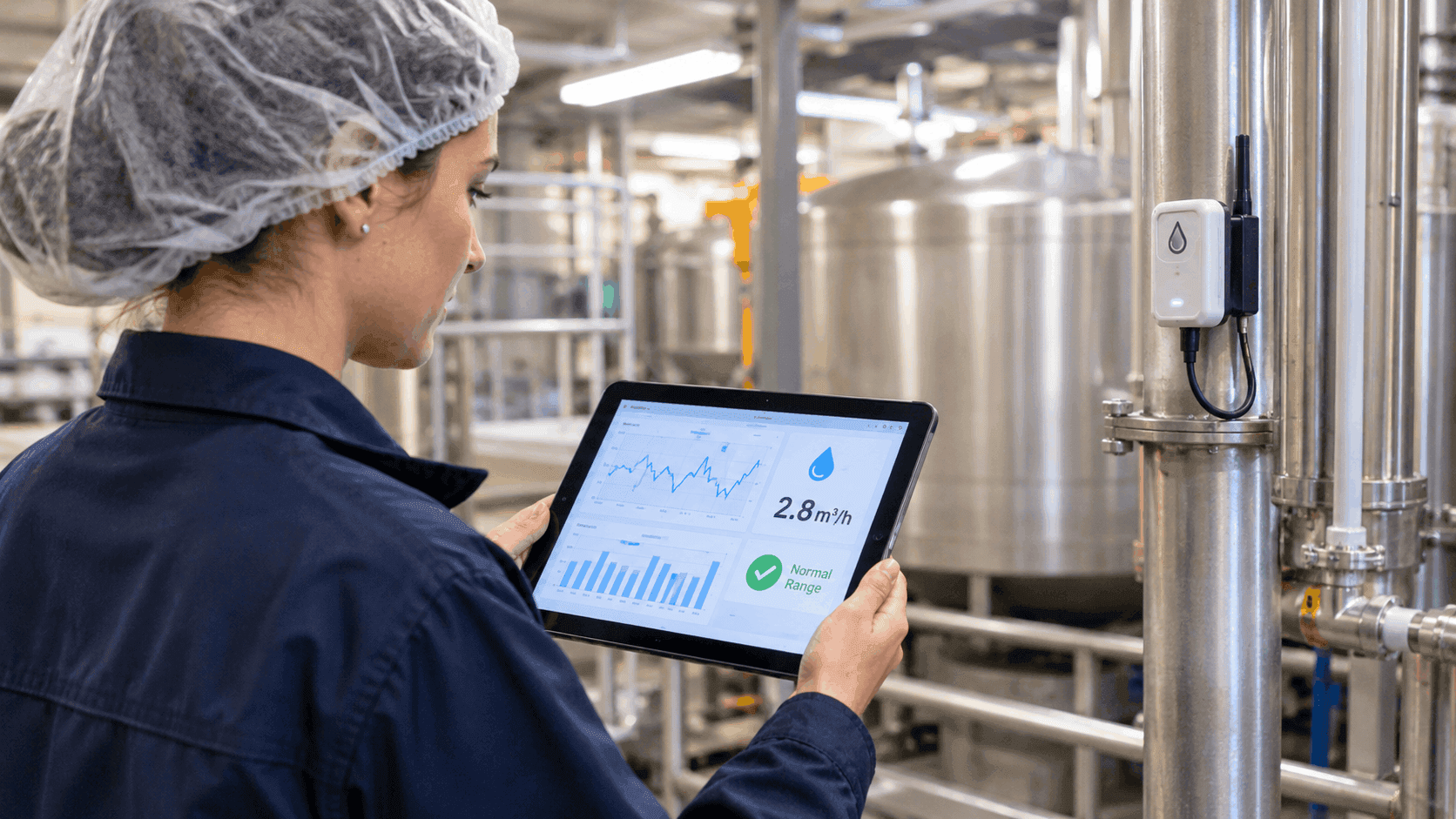
For most South Australian food and beverage manufacturers, water is one of those costs that only gets attention when the quarterly bill lands or a trade waste audit turns up a problem. Wash-downs, CIP cycles, cooling, boilers and cleaning all use water, and much of it ends up as trade waste going to SA Water's sewer.
The good news is that the tools to see what is happening between bills and audits are now practical and affordable for SA manufacturers of most sizes.
This guide looks at what has changed, which South Australian resources are worth knowing about, and how to get started.
Why Water Data Matters More Now
Trade waste is getting more visible. SA Water authorises and regulates trade waste discharges under the Water Industry Act 2012. Food and beverage manufacturers are named in SA Water's own guidance as typical "complex (industrial)" trade waste customers, where pre-treatment may be needed and discharge volumes can be large.
In 2026, industry publication Inside Water reported on SA Water's trade waste monitoring work with Kallipr. Sensors capture flow, pH, turbidity and other measures, and alarms notify a trade waste officer when a parameter moves outside a set threshold.
Following trials, the article says they are working towards rollout across 75 prioritised customers in the next 12 months, possibly extending to the top 100 to 150 customers. In practice, the regulator may see your discharge in near real time, so it pays to see it first yourself.
Leaks are expensive and easy to miss. SA Water's business smart meter case studies include Adelaide Oval, where smart meter data helped find a stuck float valve and saved more than 30 million litres, and Monarto Zoo, where one leak found through the portal was estimated to have been heading towards $10,000 and three million litres of lost water.
Step 1: Get Interval Data from Your Main Meter
SA Water offers smart meters for businesses and lists food and beverage and manufacturing among the sectors that benefit.
According to SA Water:
You get 15-minute or hourly interval readings, with daily, weekly or monthly reports emailed to you.
You can set baseflow points so that high-use and potential leak alerts are useful, not a nuisance.
Installation typically ranges from $1,500 to $7,000 (quoted per site), plus an annual fee of $147 per meter including GST.
If you want to connect your own system, SA Water can install an intermediary device on its meter for a fee. Contact [email protected] for details.
A simple first win is to look at your water use overnight and on weekends. If the line never drops to near zero when the plant is idle, you probably have a leak, a passing valve or equipment left running.
Step 2: Sub-Meter the Processes That Matter
A single site meter tells you how much, not where.
Adding IoT flow sub-meters on your biggest users, such as CIP, wash-down, boiler feed, cooling towers or a specific production line, lets you calculate litres per tonne or per batch.
That is the number that shows whether a process change, a new nozzle or a revised cleaning schedule actually worked.
For SA manufacturers looking to improve water efficiency, this process-level information can help identify where water is being used and where improvements may be possible.
Step 3: Watch Your Trade Waste Before the Audit Does
Check the SA Water trade waste guidelines and fact sheets for your sector.
There are specific documents for the dairy food industry, fruit and vegetable processing, seafood processing, small breweries and distilleries, and food waste disposal to sewer.
Then consider your own monitoring on the outlet of your pre-treatment system, for example pH and flow with alerts. That lets your team respond to a caustic dump or a failed pH correction straight away, not weeks later.
Step 4: Connect Water Data to Production Data
Water data becomes far more useful when it sits next to production data from your ERP or MES.
You can see which product, shift or cleaning cycle drove a spike, and report water intensity alongside output, which customers and sustainability reports increasingly ask for.
Connecting these systems also gives manufacturers a clearer view of how water use relates to production activity, rather than treating water consumption as a separate site-wide figure.
Getting Help with Water Monitoring in South Australia
South Australian manufacturers have several resources available when planning water monitoring and Industry 4.0 improvements.
SA Water
For smart meter enquiries, contact SA Water on 1300 729 283 or email [email protected]. You can also contact the Business Development Team at [email protected].
For trade waste questions, email [email protected] or call 08 7424 1336.
Manufacturing Growth Accelerator
The Department for State Development's Manufacturing Growth Accelerator, delivered with Flinders University's GROW program, supports SA manufacturers looking at Industry 4.0 improvements, including digital monitoring projects.
How StepSharp Helps Manufacturers Improve Water Visibility
Water efficiency is easier to manage when manufacturers can see where water is being consumed, what is entering the trade waste system and how usage changes with production activity.
StepSharp helps South Australian manufacturers bring this information together through connected IoT, ERP and MES solutions. A project could begin with monitoring a high-use process such as CIP or wash-down, then extend to flow sensors, trade waste alerts and dashboards that make unusual readings easier to identify.
By connecting water data with production information, manufacturers can also examine usage by batch, product or shift. This provides a more useful basis for identifying inefficiencies, reviewing process changes and understanding the relationship between water consumption and output.
If your business wants to move beyond quarterly bills and manual checks, contact StepSharp to discuss where connected water monitoring could make a practical difference at your site.