
Insights
React vs Vue.js — Which Frontend Framework Is Right for Your Australian Web Project?.
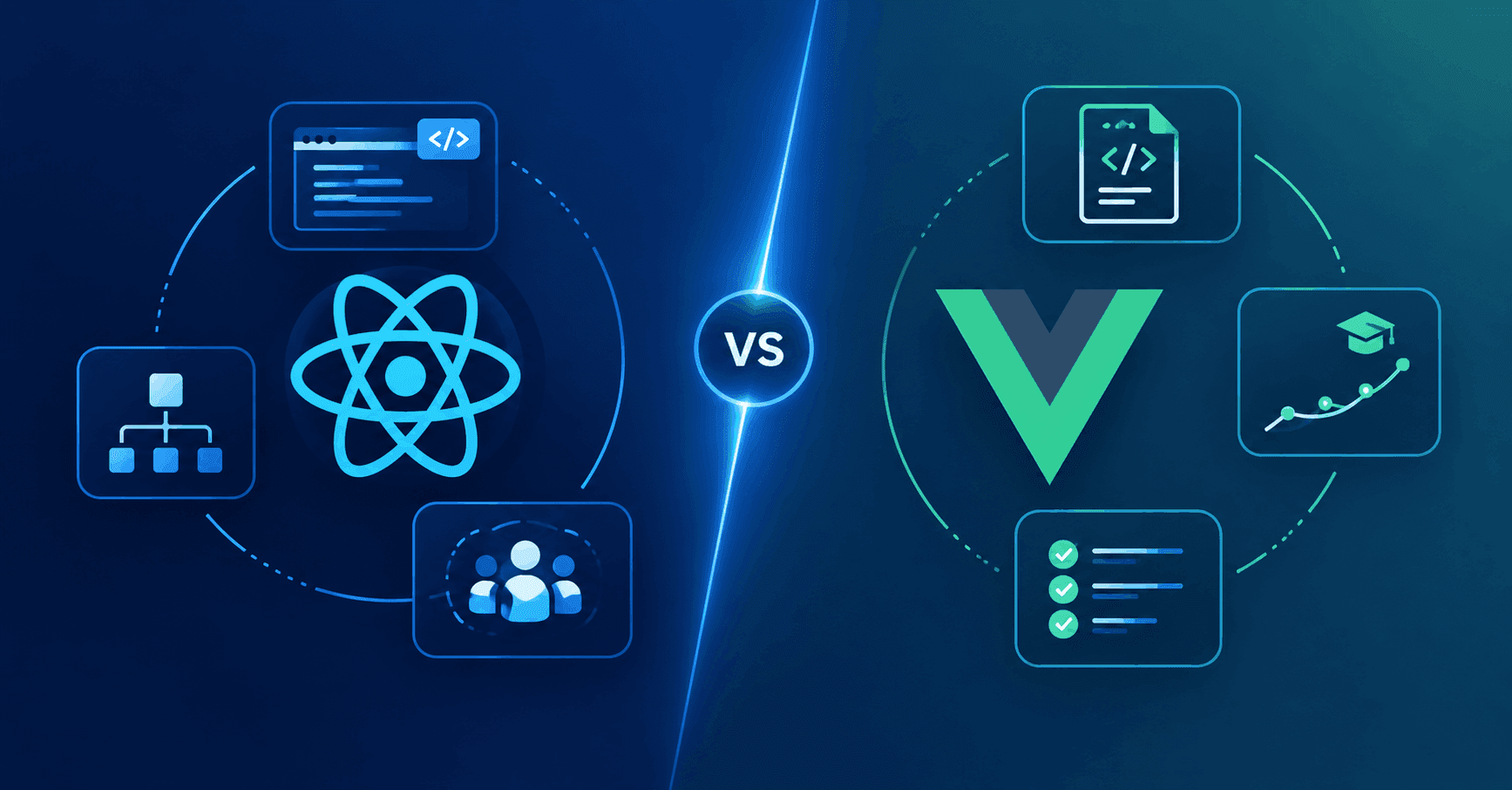
Choosing a frontend framework is one of those decisions that shapes a web project for years. It affects how quickly your team can build new features, how easily you can find developers to maintain the codebase, how well the application performs at scale, and how pleasant or painful the day-to-day development experience turns out to be. Getting it wrong is not catastrophic, but it costs time and money to course-correct.
React and Vue.js are the two most commonly recommended choices for Australian businesses commissioning custom web applications in 2026. Both are genuinely excellent. Both have large communities, strong ecosystems, and proven track records in production environments. The question is not which is technically superior, because neither is, but which is a better fit for your specific project, team, and long-term goals.
What React Actually Is
React is a JavaScript library developed by Meta and released in 2013. It handles the user interface layer of a web application and has become one of the most widely used frontend tools in the world. When people talk about React, they are usually talking about it in combination with a broader ecosystem of tools including React Router for navigation, various state management libraries, and frameworks built on top of React like Next.js.
React uses a component-based architecture, meaning the user interface is broken into independent, reusable pieces that each manage their own state and rendering. It introduced the concept of the virtual DOM, which improves rendering performance by minimising the number of direct manipulations to the actual browser DOM.
React is not opinionated. It does not prescribe how you should handle routing, state management, or data fetching. This flexibility is one of its strengths for experienced teams and one of its challenges for teams that need more guidance on how to structure a project.
What Vue.js Actually Is
Vue.js was created by Evan You, a former Google engineer, and released in 2014. It is a progressive JavaScript framework, meaning you can adopt it incrementally. You can use Vue to add interactivity to a single part of an existing page, or you can use it to build a full single-page application from scratch.
Vue is more opinionated than React in its approach. It has a clearer set of conventions for how things should be structured, which makes it easier for developers to get up to speed and for codebases to remain consistent across a team. Vue's single-file component format, where the template, script, and styles for a component live together in a single file, is widely considered to be one of the most intuitive development experiences in the frontend ecosystem.
Vue 3, the current major version, introduced the Composition API, which gives experienced developers a more flexible way to organise and reuse logic while keeping the Options API available for those who prefer its more structured approach.
Where React Has a Clear Advantage
- Ecosystem Size and Developer Availability
React's ecosystem is significantly larger than Vue's. There are more third-party libraries built specifically for React, more answered questions on Stack Overflow, and a substantially larger pool of developers with React experience in Australia. For a web development company in adelaide evaluating frameworks for a long-running project, the ease of hiring and onboarding React developers is a practical consideration that compounds over time.
- Next.js and Server-Side Rendering
The Next.js framework, built on top of React, has become one of the most capable and widely adopted full-stack web frameworks available. It handles server-side rendering, static site generation, API routes, and incremental static regeneration in a way that makes it the natural choice for performance-sensitive applications. If your project has strong requirements around SEO performance, page speed, or complex data fetching patterns, the Next.js ecosystem gives React a meaningful edge.
- Large-scale Application Architecture
For enterprise-scale applications with very large codebases and many developers working simultaneously, React's flexibility and the maturity of its associated tooling and patterns give it a slight edge. Teams with strong JavaScript expertise can leverage React's composability in ways that make very large codebases manageable.
Where Vue.js Has a Clear Advantage
- Gentler Learning Curve
Vue is consistently rated as easier to learn than React, particularly for developers who are not deeply experienced with JavaScript. The template syntax is closer to standard HTML, the component structure is more self-explanatory, and the official documentation is exceptional. For projects where the development team includes less experienced JavaScript developers, Vue can produce a faster initial velocity and a more maintainable codebase.
- Built-in Conventions Reduce Decision Fatigue
React's lack of opinion means every React project needs to make decisions about routing, state management, and component patterns that Vue handles more consistently out of the box. For teams that want to focus on building product features rather than debating architecture decisions, Vue's conventions are a genuine productivity advantage.
- Integration with Existing Projects
Vue's progressive nature makes it particularly well-suited to situations where you need to add modern frontend capability to an existing application without rebuilding the whole thing. If your adelaide web development project involves modernising parts of an existing web application rather than building from scratch, Vue's incremental adoption model is often a more practical fit than React's typically all-or-nothing approach.
How to Think About the Decision for Your Project
The most useful framework for this decision is not a feature comparison checklist but a set of honest questions about your specific situation.
- What does your development team know? If your team has strong React experience, that expertise has real value. Switching frameworks for its own sake costs productivity during transition. If your team is equally comfortable with both or is building a new team, other factors should drive the choice.
- How large and complex will the application become? For very large applications with many developers, React's ecosystem depth and the availability of experienced developers gives it a long-term maintenance advantage. For small to medium applications, Vue's conventions often produce a cleaner, more maintainable codebase with a smaller team.
- Is SEO and initial load performance critical? If your application is customer-facing and needs to perform well in organic search, Next.js and React's server-side rendering capabilities give it a meaningful advantage in this area. Vue has Nuxt.js as its equivalent, which is excellent but has a smaller ecosystem.
- What are your integration requirements? Both frameworks integrate well with most backend technologies, APIs, and third-party services. This is rarely a meaningful differentiator.
For businesses working with a software development firm in adelaide on a new web project, the framework recommendation should come from the development team based on the specific project requirements rather than being a client-driven preference. A good development partner will ask the right questions and make a recommendation they can justify, not default to whatever they build most often.
The Practical Australian Context
In the Australian market, React has a larger active developer community in every major city including Adelaide, Melbourne, and Sydney. This means finding React developers through agencies or direct hiring is somewhat easier than finding equivalent Vue expertise, which is a real consideration for businesses planning to expand their internal teams over time.
For digital workflow solutions in adelaide and broader Australian business applications, both frameworks are entirely appropriate depending on the use case. React tends to dominate in larger technology organisations and digital product companies. Vue tends to be the preferred choice in agencies and studios building client projects, where its development speed and maintainability benefits are particularly valued.
Final Thoughts
React and Vue.js are both excellent choices for Australian web projects in 2026. React brings ecosystem depth, Next.js's server-side rendering capability, and the largest developer talent pool. Vue brings a gentler learning curve, strong built-in conventions, and a development experience that consistently produces maintainable code.
The right choice is the one that fits your team, your project's complexity, and your long-term plans, not the one with the most impressive marketing or the largest conference. Work with a development partner who can make a reasoned recommendation based on your actual requirements, and you will be on solid ground regardless of which framework ends up powering your application.