Insights
Digital Traceability and Recall Readiness for SA Food Manufacturers.
South Australia's food and beverage makers, from Adelaide Hills dairies and Barossa smallgoods producers to bakeries and sauce makers in the northern suburbs, share one job they hope never to use in anger: recalling a product.
When a supplier flags a contaminated ingredient or an allergen slips onto the wrong label, the question is simple. Which batches are affected, where did they go, and how fast can you prove it?
For many SA food manufacturers, the honest answer is "give us a day or two". Records are spread across paper batch sheets, delivery dockets, a spreadsheet of customers and someone's memory. Moving that information into a connected digital system is one of the most practical upgrades a small or mid-sized food business can make.
What the Rules Already Ask of You
You don't need a new regulation to justify the work. The Australia New Zealand Food Standards Code requires food manufacturers, wholesalers and importers to have a system in place to recall unsafe food, set it out in a written document, make it available to an authorised officer on request, and follow it when recalling food (Standard 3.2.2, clause 12).
SA Health's food recall plan guidance lists the key elements of that plan:
Internal procedures and staff responsibilities for conducting a recall.
Contact details and procedures for notification.
Distribution and other records that help identify and retrieve the recalled food.
Arrangements for food retrieval and assessing returned product.
Food Standards Australia New Zealand's food traceability guidance adds that you should be able to trace all inputs, including ingredients and packaging, plus the customers who receive your product, with batch or lot identifiers, quantities, and dates of transactions and deliveries.
Its Food Industry Recall Protocol explains how to write the plan itself.
The rules describe what to record. Digital tools make it possible to pull those records together in minutes rather than days. A well-prepared food recall plan in Adelaide should therefore be supported by accessible, accurate and connected records.
The Business Case Beyond Compliance
Digital traceability offers several practical benefits for Adelaide food manufacturing businesses.
Smaller recalls: If you can pinpoint the exact lots that used a suspect ingredient, you recall those lots, not a whole week of production.
Retailer and export confidence: Supermarkets and overseas buyers increasingly expect fast answers on provenance and batch history.
Less paperwork: Operators scan or tap instead of filling in batch sheets that someone later re-keys.
Better data for costing: The same records that support a recall show real yields, waste and ingredient usage per batch.
A Practical Path From Paper to Digital Traceability
For businesses looking to improve food traceability in South Australia, the following steps provide a practical starting point.
1. Run a Mock Recall
Pick a finished product batch and time how long it takes to list every ingredient lot in it and every customer who received it. That number is your baseline.
2. Standardise Lot Codes
Make sure every incoming ingredient and packaging lot, and every finished batch, has a unique identifier that is recorded at receiving and on the line.
3. Capture Data at the Point of Work
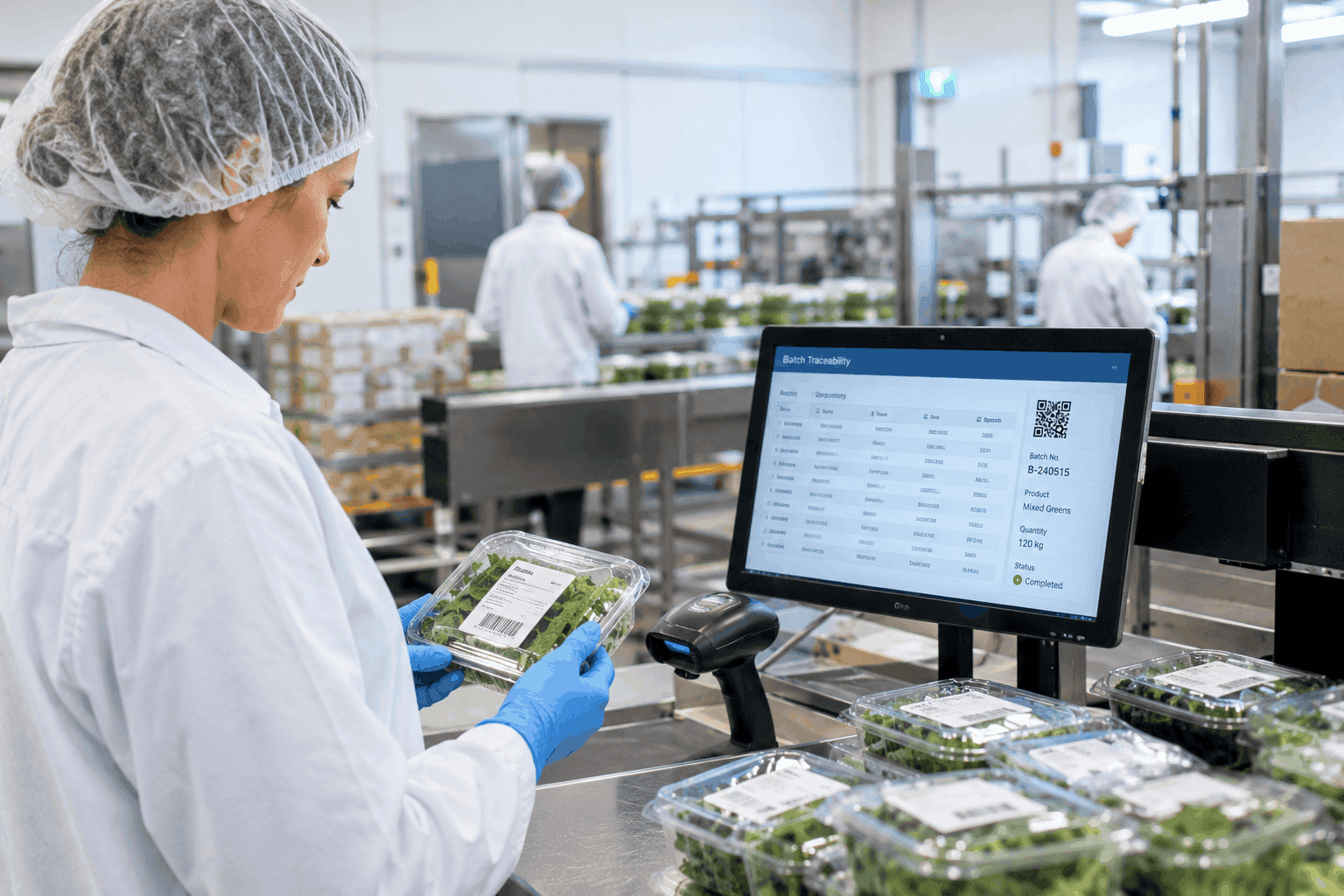
Barcode or QR scanning at goods-in, weighing and mixing stations, and dispatch removes most manual entry. This is where a manufacturing execution system (MES) earns its keep. Implementing suitable MES for food manufacturers in SA can help connect production activity with batch records.
4. Link Traceability to Orders and Dispatch
Your ERP or order system should connect each finished batch to the customer orders it filled, so "where did it go?" becomes one search.
5. Add Sensors Where Temperature Matters
IoT temperature loggers in cool rooms and on chilled lines can attach records to each batch automatically.
6. Repeat the Mock Recall
Measure the time again, and build the digital report into your written recall plan.
Using batch traceability software and connected production systems can help food businesses retrieve relevant batch, ingredient and distribution records more efficiently.
South Australian Help You Can Tap Into
South Australian food businesses can explore several local resources to support food safety, manufacturing improvements and traceability.
Food South Australia
Food South Australia, the state's peak body for the food and beverage industry, offers member resources including a Food Safety Kit and labelling guidelines.
Its membership packages include food safety plan development support at the Develop level and above.
Manufacturing Growth Accelerator at Flinders Factory of the Future
The Manufacturing Growth Accelerator at Flinders Factory of the Future is located at Tonsley.
Through its GROW program, eligible South Australian manufacturers may access up to five days under the Explore program for feasibility studies, assessments or adoption roadmaps, and up to an 80% discount on Transform projects, supported by the Department of State Development.
PIRSA's AgTech Program
PIRSA's AgTech program lists traceability solutions for producers further up the supply chain. This is useful if you buy directly from SA growers and want records that join up.
How StepSharp Can Help
StepSharp is an Adelaide-based team that implements ERP, MES, IoT and AI for South Australian manufacturers, including food manufacturers.
For traceability projects, we usually start with a mock recall to find where records break down, then put in place the smallest set of changes, such as lot scanning at goods-in, batch capture on the line and links to dispatch, that gets your recall time down without disrupting production.
We are happy to work alongside advice from Food South Australia or a Flinders Factory of the Future assessment.
Next Steps for SA Food Manufacturers
Run a timed mock recall on one product this month.
Review your written recall plan against SA Health's food recall plan checklist.
If the result was slower than you'd like, ask the Flinders Factory of the Future GROW program about an Explore assessment, or talk to a local implementation team.
A recall you can answer in minutes protects your customers, your brand and your relationships with retailers. For SA food manufacturers, digital traceability is a very practical place to start.