
Insights
Cobots for South Australian Manufacturers: A Practical Starting Guide.
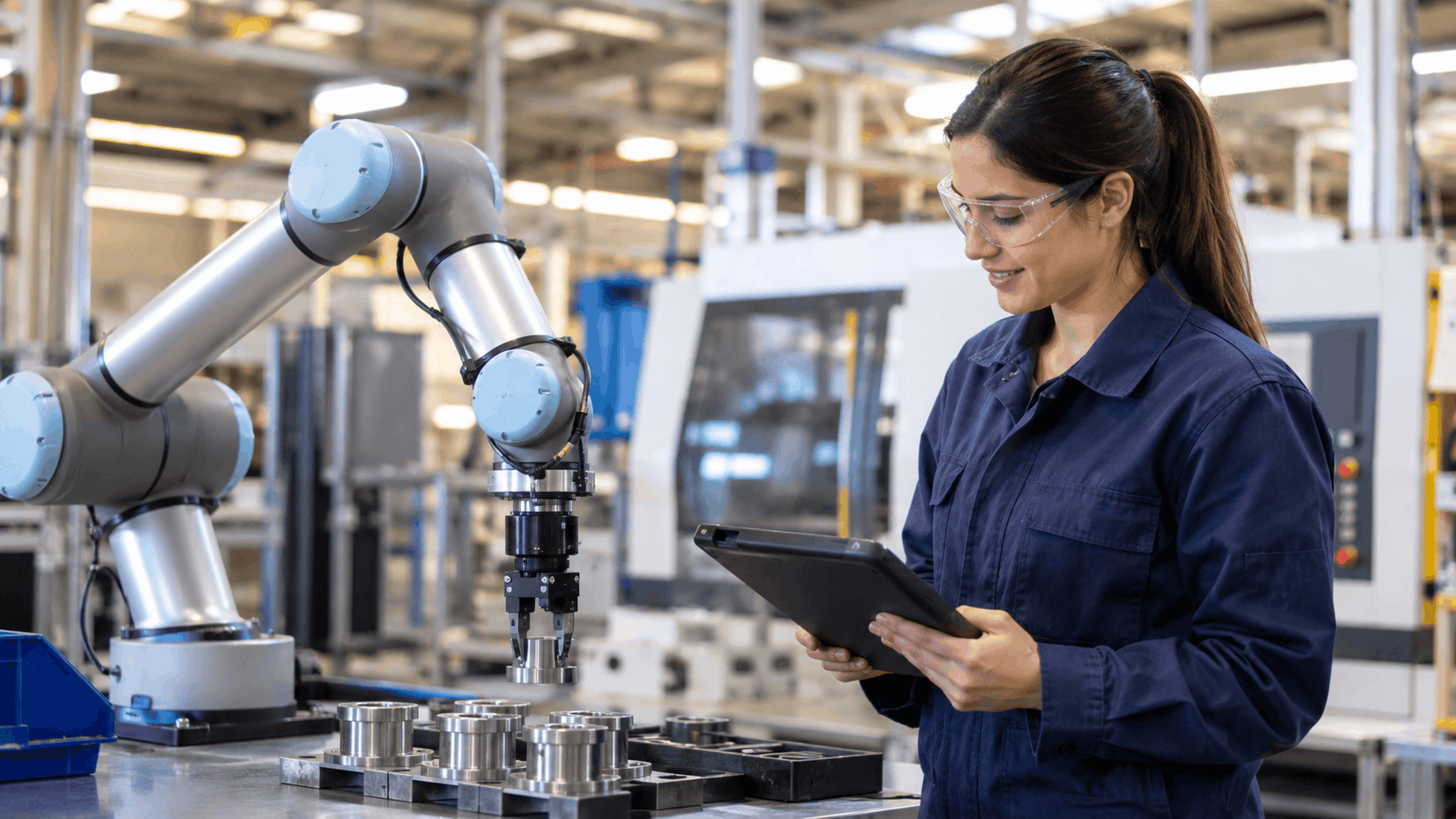
Ask most South Australian manufacturers what is holding back output and you'll hear the same answers: finding and keeping skilled staff, repetitive manual steps that cap how many units leave the floor each week, and jobs that are hard on people's bodies or expose them to fumes.
Full-scale industrial automation can feel out of reach for a small or medium business. Collaborative robots, or cobots, sit in the middle ground. They offer manufacturers a way to automate specific tasks while allowing people and robots to work alongside each other.
For businesses exploring cobots in Adelaide and across South Australia, starting with one production task can be a practical way to improve efficiency without committing to a complete factory automation project.
What Is a Cobot?
A cobot is a robot arm designed to work alongside people in a shared space, rather than behind cages on a fully automated line.
Cobots are typically smaller, easier to reprogram and quicker to redeploy than traditional industrial robots. This makes them a good fit for high-mix, lower-volume production, the kind many SA manufacturers run.
Common First Jobs for a Cobot
Cobots can support several repetitive or physically demanding manufacturing tasks, including:
Gluing and dispensing: Where consistency matters and fumes are a concern.
Welding: Especially repeat welds on standard parts.
Assembly: Putting together small components.
Machine tending: Loading and unloading CNC machines or presses.
Pick-and-place, packing and palletising: At the end of a line, including on food and beverage lines.
The goal is usually not to replace people. It's to take the repetitive, rate-limiting or hazardous step off a skilled worker so they can spend their time on work that needs judgement.
For SA manufacturers considering automation, collaborative robots can provide a practical starting point for improving production processes while keeping skilled workers involved.
South Australian Examples of Collaborative Robot Adoption
South Australia already has manufacturers exploring how cobots can address specific production challenges. These examples show why assessing one process before investing in hardware is important.
Coiltek: Automating Metal Detector Coil Production
Coiltek, a South Australian manufacturer that exports 75% of its products, found that manually gluing detector covers was a rate-limiting step that also required extra steps to manage hazardous fumes.
Through the Manufacturing Growth Accelerator, Flinders University's Factory of the Future delivered a feasibility and design study for a cobot workcell to automate the gluing process.
The result was a validated automation concept, a complete workcell layout with recommended cobot and dispensing options, and an implementation roadmap.
Coiltek then used the study to secure Manufacturing Technology Adoption Program funding to buy a cobot, dispensing tool and fume enclosure.
Sentek and Allin Towbars: Exploring Cobot Applications
In September 2025, the Department of State Development announced six new Manufacturing Growth Accelerator projects.
Two were about cobots:
Sentek is assessing how cobots can assemble moisture-sensing probes for more capacity and efficiency.
Allin Towbars is exploring how cobots can optimise welding in towbar production to improve quality and productivity.
These projects demonstrate potential applications for collaborative robots in South Australia, including assembly and cobot welding.
The common thread is that each business started with a study of one specific process before buying hardware.
Local Support for SA Manufacturers Exploring Automation
South Australian manufacturers don't have to work out their automation plans alone. Several state-supported initiatives can help eligible businesses assess new technologies and explore opportunities to improve productivity.
Manufacturing Growth Accelerator (MGA), Flinders Factory of the Future, Tonsley
The Manufacturing Growth Accelerator (MGA) is a Department of State Development partnership with Flinders University at the Tonsley Innovation District.
Eligible SMEs can take part through information sessions, Industry 4.0 assessments and bespoke accelerator projects run by Flinders researchers.
Its strategic priorities include worker-centric digital technologies for safety, productivity and quality, and human-machine learning. Every project must also consider the human factors of the technology.
Through Flinders' GROW program, eligible SA manufacturers can access up to five days of support in the Explore stage and up to an 80% discount on Transform projects.
Manufacturing Technology Adoption Program (MTAP)
The state's Manufacturing Technology Adoption Program has offered SMEs up to $50,000 in matched funding, with a minimum 1:1 co-contribution, for Industry 4.0 technologies.
Round 2 is now closed, but it's worth watching for future rounds. Coiltek's story shows how a solid feasibility study puts you in a strong position when funding opens.
SA Manufacturing Portal
Once automation lifts your capacity, make sure buyers can find you.
The free SA Manufacturing Portal, supported by the Department of State Development and ICN SA, lets local manufacturers showcase their capabilities to major project owners and other businesses.
A Practical Five-Step Starting Plan for Cobot Automation
Before investing in collaborative robots, manufacturers should understand which production task needs attention and whether automation is suitable for it.
1. Find Your Bottleneck
List the manual steps on your factory floor and pick the one that limits weekly output, causes rework, or exposes staff to strain or fumes.
2. Measure It Now
Record cycle time, units per shift, defect rate and any injuries or near misses for that step. You'll need this baseline to judge the return.
3. Run a Feasibility Study Before You Buy
Test whether the part, tolerances and changeovers suit a cobot. A program like the MGA can help here.
4. Plan for Safety and Your People
Cobots still need a proper work health and safety risk assessment for the specific task, tooling and layout.
Check your obligations with SafeWork SA, and involve the operators who'll work beside the cobot from day one.
5. Connect It to Your Data
A cobot that reports cycle counts, stoppages and output into your MES or ERP gives you real numbers on performance and makes the case for the next cell much easier.
Connecting automation equipment to production systems can also help manufacturers build a clearer picture of output and downtime.
How StepSharp Helps Manufacturers Make Automation Work
Introducing a cobot is only one part of improving a production line. Manufacturers also need to understand whether the investment is delivering better output, fewer stoppages and more consistent processes.
StepSharp helps South Australian manufacturers connect automation with the operational data needed to make those improvements measurable.
We can help your business:
Identify automation opportunities: Use production and process data to understand where repetitive tasks, bottlenecks and downtime are affecting output.
Connect equipment and systems: Bring cobots and other machinery into your MES or ERP environment so production activity and performance can be monitored.
Improve production visibility: Build dashboards that help managers and operators track cycle counts, output and downtime.
Make better-informed investment decisions: Use actual performance data to assess whether an automation project is delivering the expected results and where further improvements may be worthwhile.
For manufacturers considering a first cobot installation, the starting point is understanding the process you want to improve and the information you'll need to measure success.
If you're exploring the Manufacturing Growth Accelerator or planning an automation project, speak with StepSharp about connecting your equipment, production data and business systems to support your next stage of manufacturing growth.