Insights
AI Quality Inspection for SA Food Manufacturers: A Practical Start.
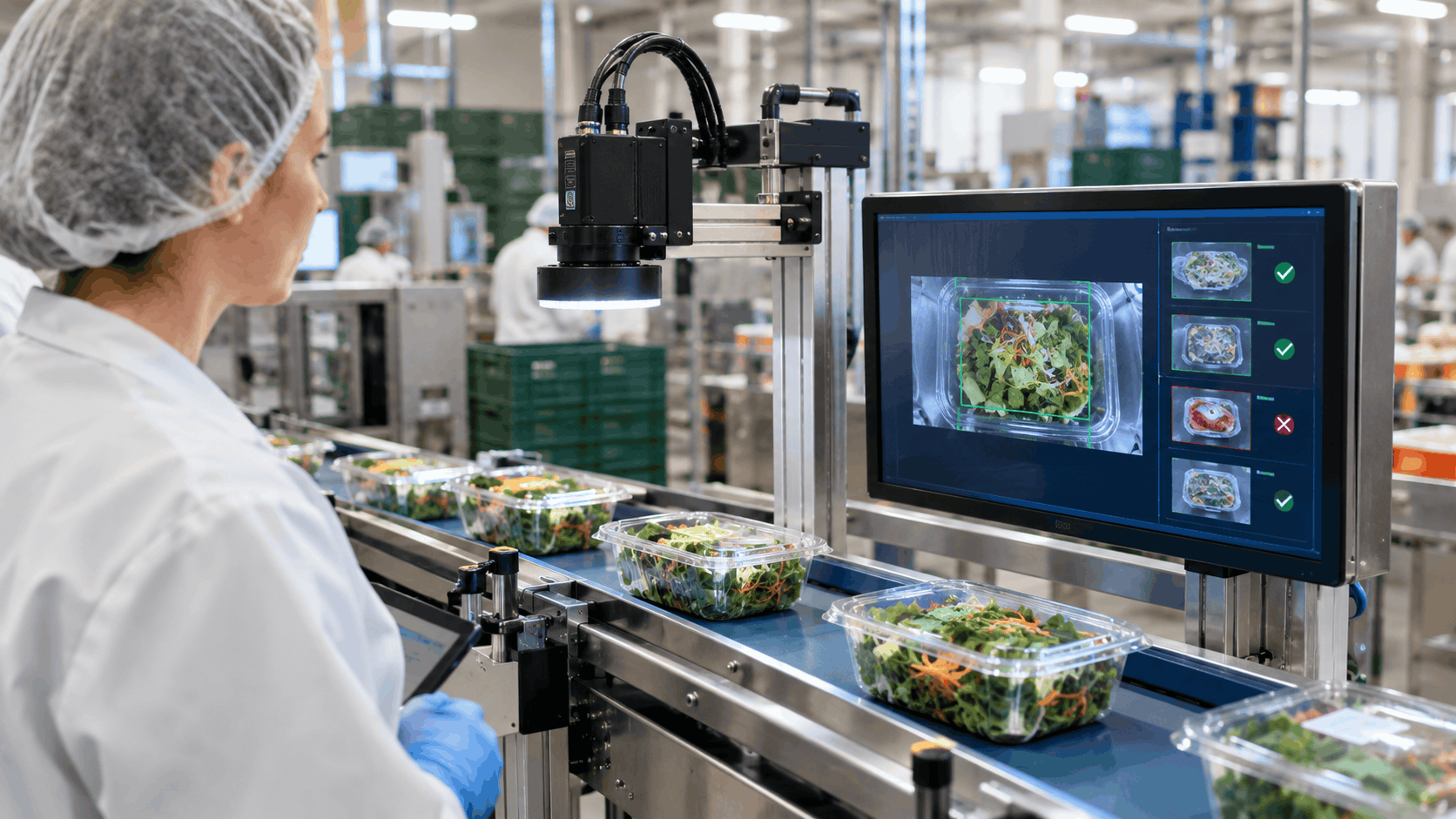
On many South Australian food and beverage lines, quality still depends on tired eyes: colour, fill level, seals, labels, or foreign matter a camera could catch every time. You do not need a full smart-factory rebuild. A focused AI quality inspection project on one product or defect type can cut scrap, protect brand reputation and give your QA team evidence retailers and auditors trust. South Australia already has local AI capability and a clear proof point in grain grading, and the same computer-vision pattern applies on packing and processing lines across Adelaide and regional SA.
Why Visual Inspection Is Hard to Scale by Hand
Human inspection varies by person, fatigue and lighting. In food manufacturing that shows up as inconsistent grading, late rejects, retailer disputes and product that should never have left the plant. AI vision systems learn from labelled images of good and bad product, then score every pack or sample that passes the camera. The point is not to replace your food-safety plan. It is to make the visual checks inside that plan faster, more consistent and easier to evidence.
A South Australian Proof Point: Cropify and AIML
Adelaide AgTech company Cropify, founded in 2019, set out to reduce subjective testing in pulse and grain crops, where human visual grading can create variability and supply-chain disputes. According to AIML’s case study, Faster, Fairer, Smarter: Cropify’s AI Grain Grading Innovation (19 May 2025), Cropify worked with the Australian Institute for Machine Learning (AIML) after a computer-vision proof of concept. With an AIML grant from the Government of South Australia in 2020, Cropify and AIML engineers built a prototype focused first on small red lentils, an important SA crop that is hard to classify by eye.
The case study reports that the technology can assess an industry-standard lentil sample in about 90 seconds, compared with a traditional 24-minute manual process, and that assessments reached accuracy rates exceeding 98% in classifying lentil samples. Further work was supported through PIRSA’s AgTech Growth Fund.
That is a useful template for SA food manufacturers: pick one visual quality problem, build a high-quality image dataset, prove the model, then decide whether to put cameras on the live line.
Local Support You Can Use
The Industrial AI SME Grant Program connects eligible South Australian SMEs with AIML’s machine learning engineers. Support comes as engineering expertise rather than a cash cheque, backed by the South Australian Government through the Department of State Development and the Research and Innovation Fund.
As the Department noted on 30 June 2025 in its article on making AI accessible to more SA businesses, the goal is to make AI accessible beyond the tech sector. AIML’s guidelines, last edited 5 March 2026, describe an AI Road Map for businesses still clarifying where AI fits, and ML Innovate for those with a clear use case and usable data. The guidelines even cite manufacturing computer vision, such as identifying product defects, as a typical ML Innovate scenario.
Eligibility includes fewer than 200 full-time equivalent employees, operating in South Australia with a physical SA premise and more than 50% of staff employed in SA, being able to contract with the university, and having enough data and leadership commitment to implement what is built. Contact AIML first at [email protected].
A Practical Starter Plan for an SA Food Line
Name one defect that already costs you money. This could be a wrong label, low fill, seal failure, colour out of spec, or grading disputes on a raw ingredient.
Define success. Focus on fewer complaints, lower scrap, faster audit retrieval, or less manual inspection time.
Collect images under real line conditions. Use the same lighting, pack variants and changeovers, with clear pass and fail examples.
Pilot offline before rejecting live product. Prove accuracy before wiring divert or stop signals.
Keep HACCP ownership with QA. Vision supports control points. Your team still owns limits and sign-off.
Decide how results enter your systems. This could be an operator display, MES event, or a linked quality action when defects cluster.
How an Adelaide Team Like StepSharp Can Help
StepSharp is an Adelaide-based team that helps South Australian manufacturers implement AI, ERP, MES and IoT in a practical way. For quality inspection, that usually means scoping cameras and lighting, connecting results to systems operators already use, and making sure the project answers a real QA question, not just producing a demo.
Cropify’s path shows what happens when a clear visual problem meets local AI development expertise and careful dataset work. If you want a second opinion on which defect to tackle first, or how inspection events should flow into production records, talk to a local implementer who understands SA manufacturing.
Next Steps
Read AIML’s Cropify case study.
Explore the Industrial AI SME Grant Program and email [email protected].
Review the Department’s note on making AI accessible to more SA businesses.
Check Business SA and PIRSA’s AgTech projects, then pick one visual defect and start collecting images before you buy hardware.
Quality you only sample by eye is quality you only partly see. For SA food manufacturers, AI inspection on a single high-impact defect is one of the most practical Industry 4.0 moves that still pays back in clearer decisions, stronger audit trails and less waste.