
Insights
When AI Gets It Wrong: Adelaide's C-Suite Dinner on AI Disasters in Critical Infrastructure.
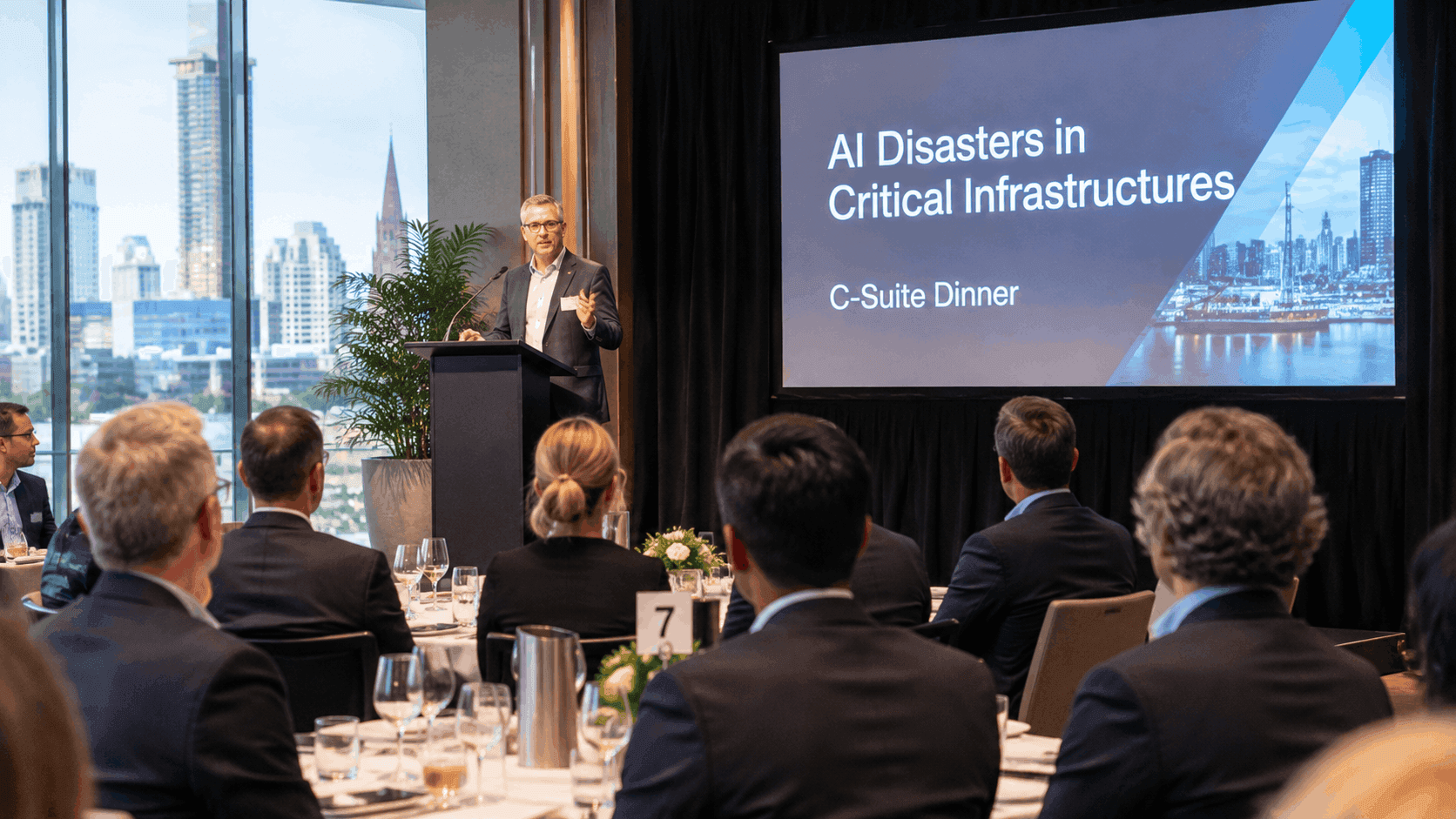
Most conversations about AI in South Australia focus on what the technology can achieve, from faster quality checks and smarter maintenance to better forecasting. However, there is another important question that every plant manager, business owner and board should be asking: what happens when AI makes the wrong decision?
This is the central theme of an upcoming Adelaide C-Suite dinner on Tuesday, 1 December 2026, hosted by the French-Australian Chamber of Commerce and Industry (FACCI), the AI Collective Adelaide Chapter and Visione Group.
For South Australian manufacturers, food and beverage processors, utilities and businesses managing critical operations, the event offers an opportunity to discuss the risks of AI adoption and understand what can happen when automated systems fail.
As AI becomes more involved in operational decisions, understanding AI risk in Adelaide and across South Australia is becoming increasingly important.
Adelaide C-Suite Dinner: Event Details
Here are the key details for businesses and senior executives interested in attending:
Event: C-Suite Dinner: AI Disasters in Critical Infrastructures
Date: Tuesday, 1 December 2026
Time: 5:30 pm to 9:30 pm (Adelaide time)
Venue: GEORGES on Waymouth, 20 Waymouth Street, Adelaide SA 5000
Organisers: French-Australian Chamber of Commerce and Industry (FACCI), AI Collective Adelaide Chapter and Visione Group
Tickets: FACCI members A$165; general admission A$185 (three-course dinner with wine included)
Registration: Book through the official FACCI event page
Enquiries: Florence Masters, [email protected]
This Adelaide business event in December 2026 is designed as a small, high-level dinner discussion for senior business leaders rather than a large conference.
What's on the Agenda? Understanding AI Disasters in Critical Infrastructure
The evening will begin with a keynote address from The Hon Chris Picton MP, listed by the organisers as Minister for State Development, AI & Digital Economy, Defence & Space Industries and Veterans' Affairs.
The discussion will then explore four key areas of AI-related risk, with each topic led by an industry organisation.
1. Operational Disasters: Yokogawa
This session explores what happens when machines make the wrong decisions. It focuses on the operational consequences of AI failures in industrial environments.
2. Cyber and Infrastructure Security Disasters: Cisco
This discussion looks at how AI can introduce new security threats and create vulnerabilities across connected infrastructure.
3. Safety and Environmental Disasters: Beca
This topic examines the real-world consequences of algorithmic decisions, particularly when automated systems affect workplace safety and the environment.
4. Trust, Reputation and Social Licence Disasters: LK
This session considers how technology failures can damage public confidence, business reputation and the trust organisations have built with their stakeholders.
The format is an intimate dinner discussion for senior leaders, encouraging practical conversations about AI risks rather than focusing on sales presentations.
Why AI Risk Matters for South Australian Manufacturers
You do not need to operate a power grid or water network to face the risks associated with AI in critical infrastructure in South Australia.
Any factory that connects machines, sensors and software to make operational decisions is managing its own form of critical infrastructure: the production line.
As industrial AI moves beyond dashboards and reporting into real-time control, quality release, production scheduling and predictive maintenance, the consequences of an incorrect decision become more significant.
For SA manufacturers, AI governance needs to be part of the implementation process, not something considered after a problem occurs.
Here are four important questions manufacturing businesses should consider.
1. Who Checks the AI Model?
What happens if an AI-powered vision system starts rejecting good products or approving defective ones?
Manufacturers need processes to monitor model performance, identify incorrect outputs and ensure important decisions are reviewed before they affect production or product quality.
2. What Is the Fallback Plan?
If a predictive model or automated scheduling system stops working correctly, can your team continue operating the production line manually?
Having a clear fallback process helps businesses maintain operations when automated systems become unavailable or produce unreliable results.
3. Is the Factory Floor Secure?
Connecting operational technology (OT) with cloud-based AI services can introduce additional entry points for cyber attackers.
Businesses need to consider network security, access controls and separation between operational equipment and other connected systems.
4. Can You Explain the AI Decision?
Customers, auditors and regulators increasingly expect businesses to maintain traceable decisions, particularly in food safety and defence supply chains.
Manufacturers should be able to understand how AI-supported decisions are made, what information influences them and who is responsible for approving critical outcomes.
Learning how large infrastructure operators approach these challenges can help smaller manufacturers establish sensible AI governance practices suited to their own operations.
South Australian Resources to Help Businesses Adopt AI Safely
Whether or not you attend the dinner, several South Australian organisations and resources can help businesses understand AI adoption, manufacturing technology and cyber security.
1. Australian Institute for Machine Learning (AIML)
Based at Lot Fourteen in Adelaide, the Australian Institute for Machine Learning works with industry on applied AI research and projects.
2. Australian Cyber Collaboration Centre (Aus3C)
The Australian Cyber Collaboration Centre, also based at Lot Fourteen, supports organisations looking to improve their cyber security capabilities.
Businesses can also explore upcoming Cyber Meet sessions and other Lot Fourteen events.
3. Flinders AMAI Toolkit
The Flinders AMAI Toolkit provides a short self-assessment to help manufacturing businesses understand their readiness for AI adoption.
4. Manufacturing Growth Accelerator
The Manufacturing Growth Accelerator, delivered through the SA Department of State Development with Flinders University's Factory of the Future, helps South Australian manufacturers plan and adopt Industry 4.0 technologies.
5. Australian Signals Directorate: Operational Technology Cyber Security
The Australian Signals Directorate provides practical guidance through its principles of operational technology cyber security.
These principles offer a useful starting point for businesses looking to secure connected factory equipment and operational systems.
Four Questions to Take to the AI C-Suite Dinner
If you are attending the event, consider bringing these questions back to your own organisation:
Which of our current or planned AI applications could cause significant harm if they failed without anyone noticing?
Do we have a human in the loop for safety-critical or quality-critical decisions?
Who is responsible for AI risk in our business: IT, operations or another team?
Are our operational technology networks separated from the systems that our AI tools connect to?
These questions can help business leaders identify gaps in their current processes and establish a clearer approach to AI governance.
How StepSharp Helps Manufacturers Build Safer, More Reliable AI Systems
Introducing AI into manufacturing is not just about automating tasks or making faster decisions. It is equally important to understand how those decisions affect production, product quality, workplace safety and business continuity.
StepSharp works with South Australian manufacturers and food producers to implement connected technology solutions across AI, ERP, MES and IoT environments.
Our focus is on helping businesses introduce technology in a controlled and practical way, with appropriate safeguards built into the solution from the beginning.
This includes helping manufacturers:
Maintain control over critical decisions: Design AI-supported workflows with appropriate human review and approval wherever production quality or safety is involved.
Improve operational visibility: Use connected ERP, MES and IoT systems to monitor production activities, identify unusual results and provide better access to operational information.
Reduce dependency on disconnected systems: Integrate business applications and factory-floor technology so that AI solutions work with reliable, relevant data.
Plan for system failures: Consider manual processes, fallback arrangements and recovery procedures so that essential operations can continue when automated systems are unavailable.
Strengthen system security: Take a structured approach to connecting operational technology with business applications and external AI services.
Every manufacturing environment has different requirements. A food processing facility, for example, may need tighter controls around quality checks and traceability, while another manufacturer may prioritise production scheduling or equipment monitoring.
StepSharp helps businesses assess these requirements before deciding where AI makes sense and which systems need to be connected first.
If your business is exploring industrial AI, improving existing manufacturing systems or planning a new automation project, speak with StepSharp about practical AI and manufacturing technology solutions.
Plan Your December: Attend the AI Disasters in Critical Infrastructure Dinner
The C-Suite Dinner: AI Disasters in Critical Infrastructures will take place on Tuesday, 1 December 2026, from 5:30 pm to 9:30 pm, at GEORGES on Waymouth, Adelaide.
For senior executives, manufacturers and business leaders interested in AI risk, industrial automation and operational technology cyber security in SA, the event offers an opportunity to hear different industry perspectives and discuss the challenges of AI adoption.
Seats for this dinner-format event are limited. Visit the official FACCI event registration page to check availability and book your place.