Insights
AI Development in Perth — What Mining and Logistics Businesses Need to Know.
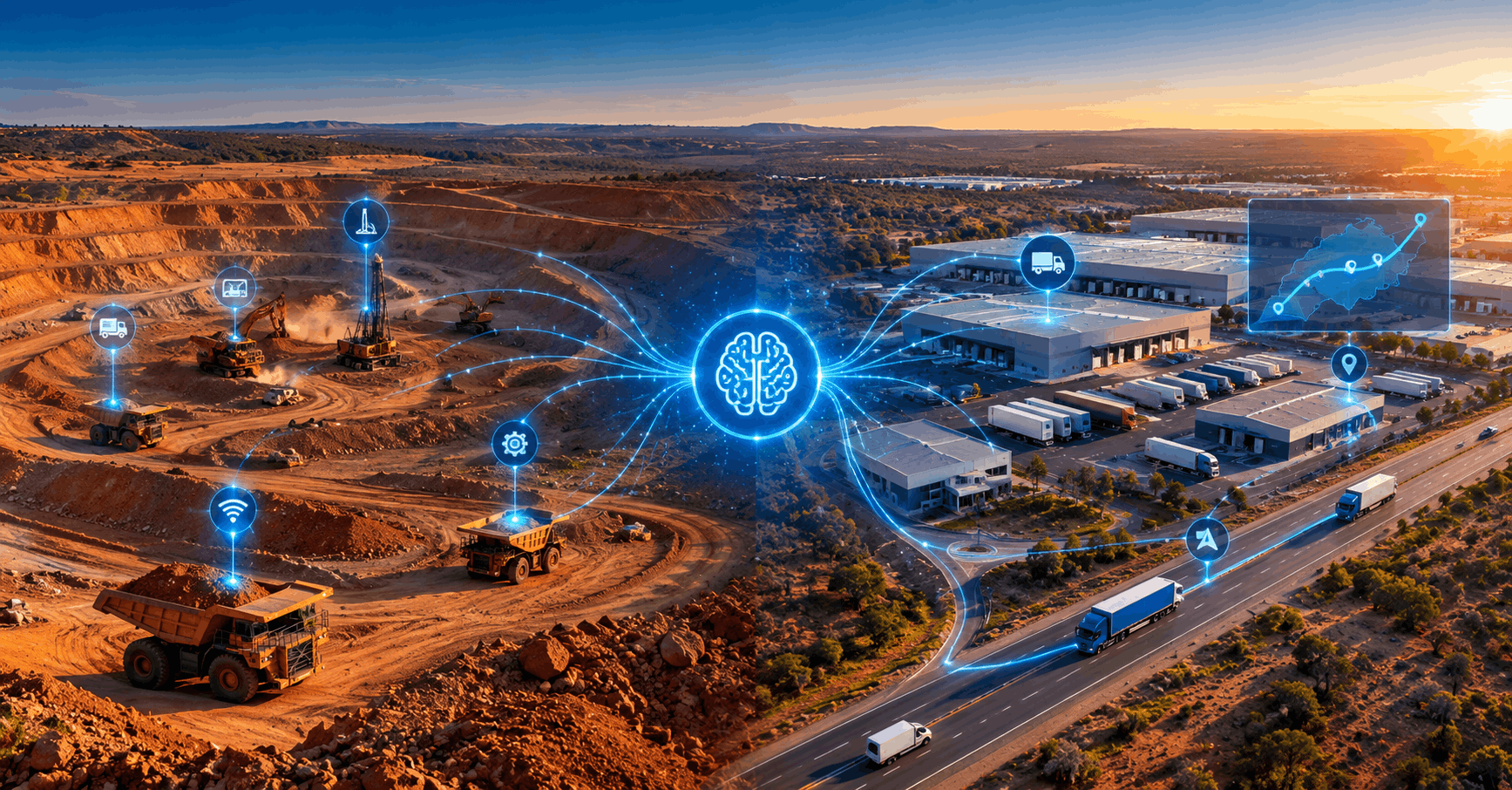
Perth sits at the centre of two of Australia's most operationally intensive industries. Mining and resources on one side, logistics and supply chain on the other. Both run on data, both operate across vast distances, and both have workflows that generate more information than most organisations know what to do with. Which is exactly why artificial intelligence is finding so much traction in Western Australia's business community right now.
This is not about replacing people or chasing technology trends. It is about applying intelligence to the specific operational problems that Perth businesses deal with every day, and doing it in ways that produce measurable, practical outcomes rather than impressive demonstrations.
Why Perth's Industries Are Particularly Well Suited to AI
The characteristics of Perth's dominant industries align unusually well with where AI currently delivers its strongest results.
Mining and resources operations generate enormous volumes of sensor data, equipment telemetry, maintenance records, and safety incident reports. Most of this data sits in systems that do not talk to each other, analysed by people who can only review a fraction of what is available, with the remainder going unexamined until something goes wrong. AI systems that can continuously monitor this data, identify anomalies before they become failures, and surface relevant patterns across datasets that no human team could manually review are not theoretical benefits for Perth's resources sector. They are solving problems that cost money and risk lives every day.
Logistics operations face a different but equally well-suited challenge. Route optimisation, demand forecasting, warehouse inventory management, driver scheduling, and exception management across distributed networks all involve the kind of high-volume, repetitive decision-making that AI handles efficiently and at a consistency level that manual processes cannot match.
Both industries also operate outside standard business hours and across locations that are not always well connected. Software that can function reliably in these environments, making decisions or surfacing information without requiring a person to be physically present, addresses one of Perth's most practical operational realities.
What AI Actually Delivers for Resources Operations
The applications generating the most practical value for Perth's resources and mining-adjacent businesses fall into a few consistent categories.
- Predictive maintenance. Equipment failure on a mine site is expensive in parts and replacement costs, but the real cost is in unplanned downtime and the operational cascade that follows. AI systems that analyse equipment telemetry and maintenance history to identify failure signatures before they produce an incident have demonstrated meaningful reductions in unplanned downtime across resources operations. The system does not replace the maintenance team. It tells them what to look at and when, so they are acting before the problem rather than after it.
- Document processing and compliance automation. Mining operations generate a continuous stream of compliance documentation, safety reports, incident records, and contractor management paperwork. AI document processing systems that extract, classify, and route information from these documents reduce the administrative overhead on site teams and reduce the risk of compliance gaps that occur when documentation volumes exceed human capacity to review them thoroughly.
- Operational reporting and decision support. Many Perth resources businesses have data spread across multiple systems with no unified view of operations. AI systems that consolidate operational data and surface the specific signals that decision-makers need, presented in a format that supports rather than requires interpretation, address a genuine gap between the data that exists and the intelligence that reaches the right people at the right time.
What AI Delivers for Logistics and Supply Chain Operations
For Perth logistics businesses, the most practically valuable AI applications cluster around a different set of problems.
Route and Schedule Optimisation
The scale of logistics operations in Western Australia, with distances between destinations that are genuinely vast by eastern-states standards, makes route optimisation a high-value problem. AI systems that optimise routes and schedules across large fleets in real time, accounting for changing conditions, delivery priorities, and vehicle constraints, produce fuel savings, improved delivery reliability, and better driver utilisation than manually managed scheduling can achieve at scale.
Demand Forecasting
Inventory management across distributed warehouses or supply points requires accurate forecasting of what will be needed, where, and when. AI forecasting systems that incorporate historical patterns, seasonal factors, and external signals produce more reliable demand predictions than traditional statistical models, reducing both overstock costs and the operational disruption of shortages.
Exception Management
In large logistics operations, the exception, such as a delayed shipment, a missing item, or a vehicle off route, is what consumes disproportionate management time. AI systems that continuously monitor operations and surface exceptions as they develop, rather than after they have already caused downstream problems, allow teams to focus on the situations that actually need human judgement rather than monitoring everything simultaneously.
The Implementation Reality for Perth Businesses
Understanding where AI delivers value is useful. Understanding what implementing it actually involves is what allows businesses to make informed decisions rather than being sold outcomes that do not materialise.
The most successful AI implementations in Perth's resources and logistics sectors share common characteristics. They start with a clearly defined operational problem rather than a technology-first brief. They work with the data that actually exists in the business rather than requiring a data transformation project to be completed before AI work can begin. They are built with the operating environment in mind, including offline reliability requirements for remote sites and mobile-first interfaces for field teams. And they include human oversight at the decision points where the consequences of an AI error would be significant.
The businesses that struggle with AI implementation tend to have approached it from the opposite direction, starting with the technology and working backward to find a problem it might solve, or expecting AI to compensate for data quality and process problems that need to be addressed first.
Working with an experienced ai development company in Adelaide that has delivered AI systems in operational environments, rather than a consulting firm that proposes frameworks without building them, is one of the most practically important choices a Perth business makes when evaluating AI investment.
Why the Development Partner Matters in Perth's Context
Perth businesses working with software and AI development partners face a specific version of a challenge that all Australian businesses outside Sydney and Melbourne deal with: finding a partner with genuine engineering capability who can also communicate effectively within Western Australian working hours and who understands the operational realities of the industries they are building for.
The answer for many Perth businesses has been to work with Australian development teams that structure their delivery around Perth's timezone and bring experience building for the specific conditions, such as remote connectivity requirements, field-based use, and operational data integration, that Perth's industries present.
AI application development in Adelaide delivered by teams with genuine operational AI experience is increasingly the practical choice for Perth businesses that want Australian engineering standards without the offshore risk or the east-coast timezone friction. The engineering capability is the same regardless of where the team is based. What matters is the experience, the communication structure, and the willingness to understand the operational environment before recommending a technical approach.
Final Thoughts
AI development in Perth is not a future investment. It is a present one, being made right now by mining and resources businesses that want fewer unplanned equipment failures, by logistics operators that want better utilisation of large fleets across long distances, and by the broader range of Perth businesses dealing with operational complexity that manual processes and legacy systems were not designed to handle.
The businesses getting the most value from it are those that started with a specific operational problem, chose a development partner with genuine implementation experience, and approached it as an operational improvement project rather than a technology experiment. That combination, a real problem, experienced ai development company in Adelaide capability, and an operational rather than experimental mindset, is what produces AI systems that earn their place in daily operations rather than sitting unused after an impressive demonstration.