
Insights
AI Applications in the Grains Industry — What Australian Grain Growers Need to Know in 2026.
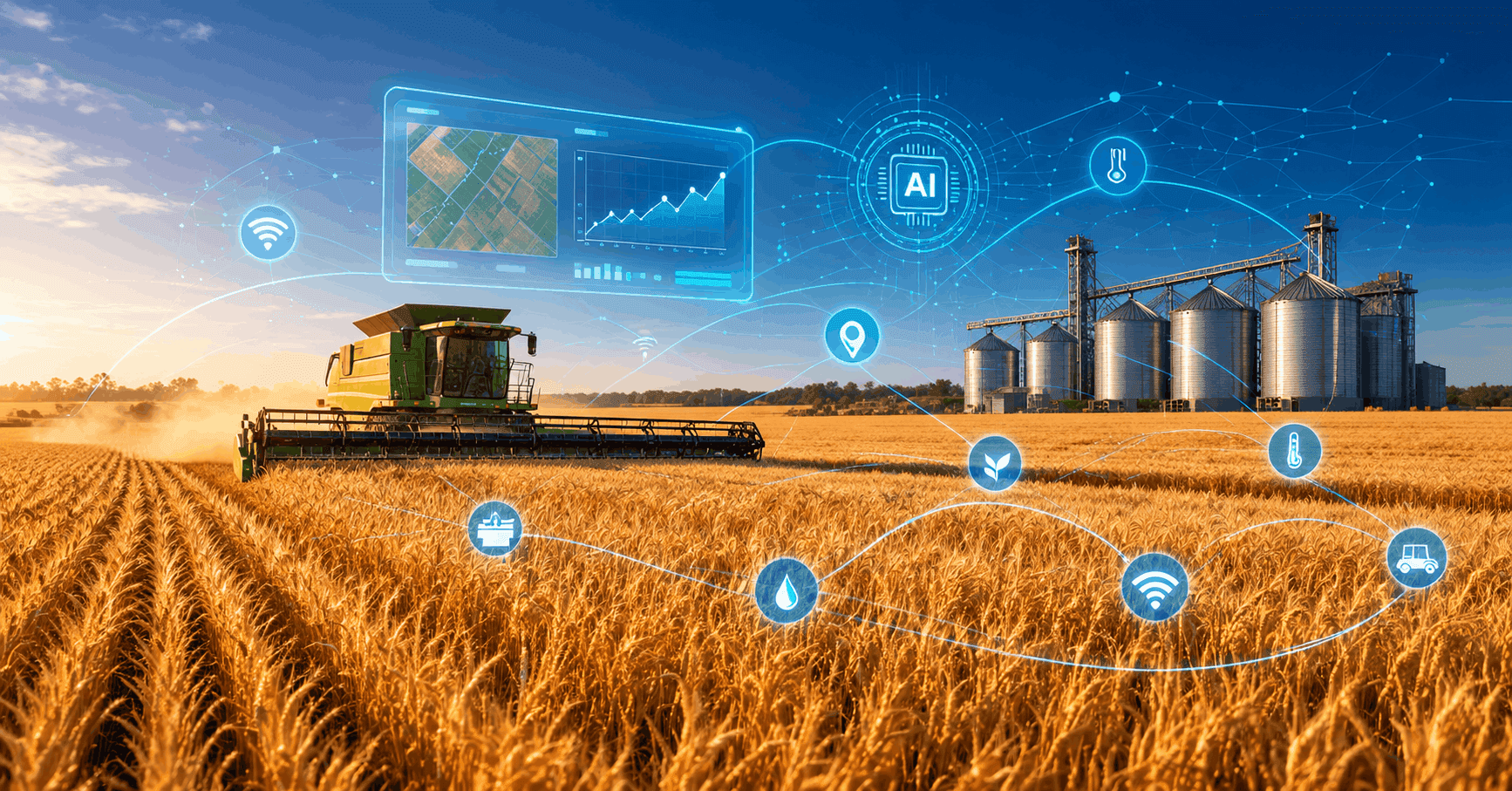
Australian grain growing has always been a discipline that rewards precision. The difference between a good season and a great one, between a profitable harvest and a marginal one, often comes down to the quality of decisions made under uncertainty — about when to plant, when to spray, when to harvest, and how to store what is brought in. For generations, those decisions relied on experience, observation, and the kind of accumulated practical knowledge that is passed down through farming families and agronomic advisers.
In 2026, a new layer of decision-making intelligence is becoming available to Australian grain growers, and the organisations at the forefront of making it practically deployable are beginning to close the gap between AI's theoretical potential in agriculture and what growers can actually put to work on their operations this season or next.
What AI Actually Means in a Grains Context
Before getting into specific applications, it is worth being clear about what artificial intelligence means in the context of a grains operation, because the term covers a broad range of capabilities that are not equally relevant or equally mature.
At the most practical end of the spectrum, AI in grains means machine learning models that can analyse historical yield data alongside soil, weather, and input data to produce more accurate yield forecasts than traditional modelling approaches. It means computer vision systems that can assess grain quality at intake with a speed and consistency that human inspection cannot match. It means predictive maintenance systems that monitor grain storage equipment and alert operators to developing issues before they result in a breakdown that costs both time and grain quality. And it means decision support tools that surface the right information to the right person at the right time, rather than leaving farm managers to extract insight manually from disparate data sources.
At the more sophisticated end, it means autonomous or semi-autonomous systems that can manage irrigation, monitor crop health through drone imagery, and adjust agronomic recommendations in real time based on incoming sensor data. These applications are further along the development curve, but the foundational work being done now is what makes them practical within the next few years.
The GRDC Proof-of-Concept Fund — A Practical Pathway for AI in Australian Grains
The Grains Research and Development Corporation is an Australian statutory body funded jointly by grain growers and the federal government, with a mandate to invest in research and development that improves the profitability and sustainability of Australia's grains industry. GRDC funds R&D across the full range of grains crops including wheat, barley, canola, and pulses, and its investment spans everything from plant breeding and agronomy through to farm management systems and digital agriculture.
One of the most practically relevant funding mechanisms available to technology providers right now is GRDC's proof-of-concept fund, which offers up to $250,000 excluding GST with 1:1 matching for new AI proof-of-concept projects in the grains industry, to be completed within 18 months. This is a genuinely significant funding mechanism for technology companies and grower groups that want to test the practical application of AI solutions in grain growing contexts without bearing the full development cost independently.
For technology providers with proven AI capability in adjacent industries, this fund represents an opportunity to translate existing expertise into grains-specific applications with co-investment support. The 18-month completion timeline is realistic for a well-scoped proof-of-concept, and the matching structure means that the total project budget available for a well-funded applicant is up to $500,000 when the applicant's own matching contribution is included.
Where Manufacturing AI Experience Carries Directly Into Grains
One of the less obvious but practically important observations about AI in the grains industry is how much of the foundational work resembles challenges that manufacturing and food processing operations have already solved. The gap between manufacturing AI implementation and agricultural AI implementation is narrower than it appears, and organisations with deep experience deploying AI alongside ERP, MES, and IoT systems in manufacturing environments bring directly applicable capability to the grains context.
Consider grain receival and storage operations. The challenge of monitoring grain quality, managing temperature and moisture across multiple storage cells, scheduling aeration systems in response to environmental conditions, and predicting quality degradation over time is structurally similar to the challenge of managing quality and condition across a manufacturing plant with multiple processing lines and environmental monitoring requirements. The sensor infrastructure, the data integration approaches, the alert logic, and the decision support interfaces are all disciplines that manufacturing AI implementation has developed in depth.
Predictive maintenance for harvesting equipment, grain augers, conveyors, and storage fans follows the same logic as predictive maintenance for industrial machinery. The principles of monitoring equipment telemetry, identifying failure signatures in the data, and generating maintenance recommendations before a breakdown occurs are directly portable from a manufacturing context into a grains operation.
Supply chain integration, traceability, and quality documentation across the grain supply chain from paddock to port share significant common ground with the traceability and quality management challenges that food manufacturers deal with every day. ERP and MES systems that manage these workflows in manufacturing can be adapted and extended to address the equivalent challenges in grains with significantly less foundational work than building from scratch.
StepSharp's work implementing AI development services alongside ERP, MES, and IoT systems for manufacturers positions the team to bring this cross-industry experience directly to bear on grains-specific AI proof-of-concept work, translating proven approaches from manufacturing environments into the practical realities of Australian grain growing and handling operations.
The Specific Applications Worth Investigating Now
For grain growers and agribusiness operators assessing where AI investment is most likely to deliver practical value, a few application areas stand out as being both technically mature and practically relevant to Australian conditions.
Grain Quality Assessment at Intake
Computer vision and near-infrared spectroscopy combined with machine learning are producing intake quality assessment systems that are faster, more consistent, and more detailed than manual assessment. For receival operations handling high volumes during harvest, the efficiency and quality assurance benefits are significant.
Storage Condition Monitoring and Management
AI systems that continuously monitor temperature, moisture, and carbon dioxide levels across multiple storage cells, recommend aeration interventions, and alert managers to developing quality risks have moved from experimental to practical in several Australian grain storage contexts. The sensor infrastructure required is increasingly affordable and the integration with existing storage management systems is achievable with well-designed middleware.
Yield Prediction and Input Optimisation
Machine learning models that analyse historical yield data alongside satellite imagery, soil data, and seasonal climate forecasts are producing yield predictions that allow more precise input planning and financial forecasting than traditional approaches. These systems are most powerful when they are trained on data from the specific farming systems and environments they are applied to, which is one of the reasons proof-of-concept work in defined geographic and agronomic contexts is so valuable.
Harvest Logistics Optimisation
Scheduling harvesting equipment, grain cart movements, and receival logistics to minimise downtime and maximise throughput during the harvest window is a complex optimisation problem that AI scheduling systems handle well. For large broadacre operations where harvest logistics directly affect the volume that can be captured in optimal grain moisture windows, the value of optimised scheduling is measurable in tonnes.
What the Path Forward Looks Like
For Australian grain growers and agribusiness operators who want to move from interest in AI to practical deployment, the most productive starting point is identifying the specific operational problem where better information or better decision support would have the most material impact on outcomes. Not the most impressive-sounding application, but the one where the gap between what currently happens and what could happen is largest and most consequential.
From there, scoping a proof-of-concept that tests the AI approach in a controlled, real-world context, with clear success metrics established before the work begins, is what allows the investment to be evaluated honestly and the learning to be applied to further development.
The availability of GRDC proof-of-concept funding makes this pathway more financially accessible than it would otherwise be, and the 18-month timeline creates a structured context for moving from concept to validated result. For technology providers with relevant AI implementation experience, partnering with a grower group or agribusiness operator to develop a jointly scoped proof-of-concept application is the most direct path to contributing meaningfully to AI adoption in the Australian grains industry.
Final Thoughts
AI applications in the grains industry are moving from speculative to practical, and the growers and agribusiness operators who engage with this shift now, through proof-of-concept work, pilot deployments, and honest evaluation of where AI adds genuine operational value, will be better positioned than those who wait for the technology to fully mature before engaging with it.
The GRDC proof-of-concept fund provides a structured, co-funded mechanism for exactly this kind of exploratory but disciplined investment. For technology providers with proven AI capability in manufacturing and industrial environments, and for grain growers and agribusiness operators with specific operational challenges that AI could address, the combination of available funding, maturing technology, and cross-industry experience creates a genuine opportunity to accelerate practical AI adoption in one of Australia's most important agricultural sectors.